Six things a shop needs. Nothing it doesn’t.
We removed everything a corner shop does not use. What is left is the daily book, the credit list, your stock, reports written in sentences, your people, and the ability to work when the network is poor.
- 01 Daily book
- 02 Credit & reminders
- 03 Inventory
- 04 Reports
- 05 Staff & branches
- 06 Offline & low data
Record the day, not every transaction.
This is the difference between MyKanti and a point-of-sale system. A till expects you to stop and enter every sachet of water. You will not do that, and neither will your attendant. So MyKanti asks for the day: what came in, what went out, and what you kept.
Two-minute close
Enter total sales and total expenses, tag the expenses (stock, transport, rent, dash) and save.
Every-sale mode, if you want it
Turn it on per shop. Attendants log each sale from their own phone; the day still closes the same way.
Missed a day? It waits for you
Back-date any entry. MyKanti reminds you at your chosen hour instead of scolding you with red numbers.
Stop being the one who has to ask.
Credit is how neighbourhood trade works — and it is where shops quietly lose their profit. Asking a customer for money face to face damages the relationship. A polite scheduled message does not.
Ageing you can see
Debts sort by age. Anything past 30 days turns red on its own.
Part payments
Record ₦5,000 today, ₦5,000 next week. The balance updates and both sides get a receipt.
Credit limits
Set a ceiling per customer. Your attendant is warned before giving more.
Wording you approve
Edit the reminder once. Every one after that is written in the same words.
Reminder ready to send at 9:00 AM
To: Mama Blessing
Good morning Ma. This is a gentle reminder from Ade Stores: your balance is ₦18,500 from 10 July. Thank you.
You approve the tone once. After that MyKanti writes it for you whenever it is due — you tap send, and it goes from your own number.
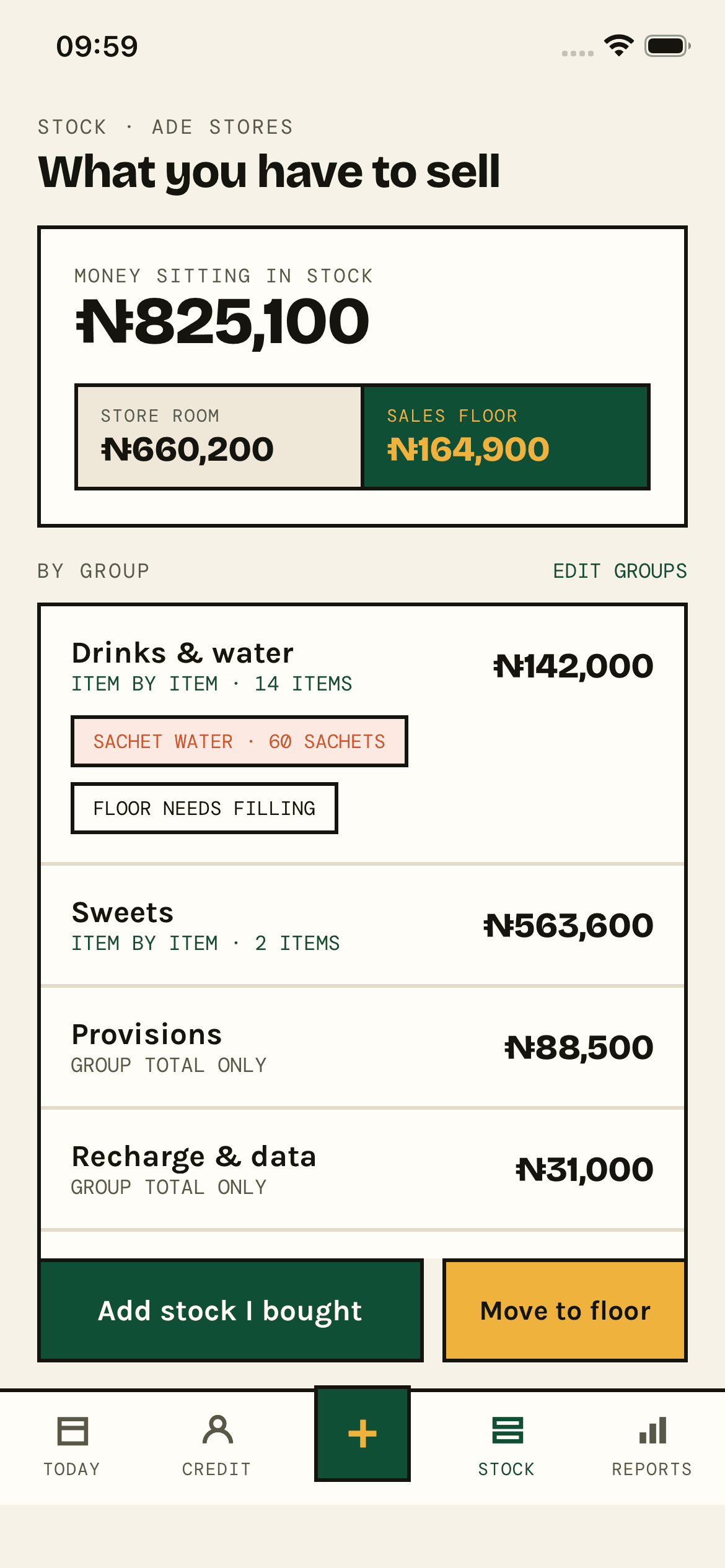
Track your stock as loosely or as tightly as you like.
Nobody counts 400 items every night. So MyKanti lets you choose the depth — and change your mind later without losing your history.
Level 1 — by group
Most shopsGive each part of the shop a value. Enter what you buy in, and MyKanti works out what is left.
Level 2 — item by item
Growing shopsCartons, packs and pieces, with cost and selling price. You get low-stock warnings and true profit per item.
Advanced underneath. Simple on top.
The top layer is six sentences about your month. Under each sentence is the calculation, the period comparison and the raw records — for you, your accountant, or a lender who needs proof.
MONTH
₦1,432,000
Money in
MONTH
₦1,081,000
Money out
YOURS
₦351,000
Real profit
HELD
₦137,000
Out on credit
Day of week
Friday and Saturday carry 42% of your month. Sunday is your quietest day — restock Thursday evening, before the rush.
Slow money
₦34,000 of stock has not moved in 60 days. Consider a bundle price to free the cash.
Expenses
Generator fuel is up 28% on last month. It is now your third-largest cost.
- Export to PDF
- Export to Excel
- Share with accountant
- Loan-ready summary
Trust, with a record of it.
Add your attendant with a limited login. They can enter sales and credit; they cannot see profit, change prices or delete anything. Every entry carries a name and a time, so questions get answered by the record instead of by argument.
Built for the network you actually have.
Everything you type is saved on the phone first. When signal returns it syncs quietly in the background. No spinning wheels, no lost entry because NEPA took light and the router went off.
Android, iPhone, and any browser
Same records everywhere. Use the phone in the shop and the laptop at home.
Light on data
A month of daily closing uses roughly the data of a short voice note.